Beyond the Arabesque: Unveiling the Secret Life of Eslimi
Beyond the Arabesque - Discover the hidden history of Persian Eslimi patterns. We explore the distinction between animal and floral motifs and the philosophy of the infinite in Islamic art.
STUDIO INSIGHTSART HISTORY
The Whisper of the Infinite
If you have ever stood beneath the towering arch of a mosque in Isfahan, or lost yourself in the azure depths of a finely knotted Tabriz carpet, you have felt the pull of the spiral. Your eye catches a vine, follows its rhythmic curve, and suddenly, you are swept into a dance that seems to have no beginning and no end.
To the Western world, this mesmerising interplay of scrolling vines and geometric precision is known as the "Arabesque." It is a beautiful word for an attractive form, evocative of exotic travels and distant lands. But within the walls of traditional Persian art, this pattern holds an older name and a hidden history.
Welcome to the secret life of the Eslimi.
While the world sees a decoration, the master artist sees a philosophy. Understanding the nuances between "Arabesque" and "Eslimi" enables a deeper appreciation of these structures. It reveals that this art is not merely about ornamentation; it is about capturing the breath of the infinite.
A Tale of Two Names
To a 19th-century European observer, the interlacing foliage in Islamic architecture was simply "in the Arab style", hence, the Arabesque. It was a catch-all term, a frantic attempt to categorise a beauty that defied Western artistic norms of perspective and realism.
However, the native heart of this art form beats to the rhythm of Eslimi (or Islimi).
Eslimi is one of the three pillars of traditional Iranian aesthetic, alongside calligraphy and geometry. Its roots extend far beyond the Islamic Golden Age to the Sassanid era, demonstrating that art, like culture, is a continuous river rather than a stagnant pond. While "Arabesque" describes the surface, "Eslimi" describes the soul.
The Hidden Distinction: The Elephant and the Flower
Here lies a secret mainly known to the masters of Tazhib (the art of illumination). When we examine a complex Persian pattern, we often assume it depicts vines and flowers. But the Eslimi tells a different story.
Not all scrolls are created equal.
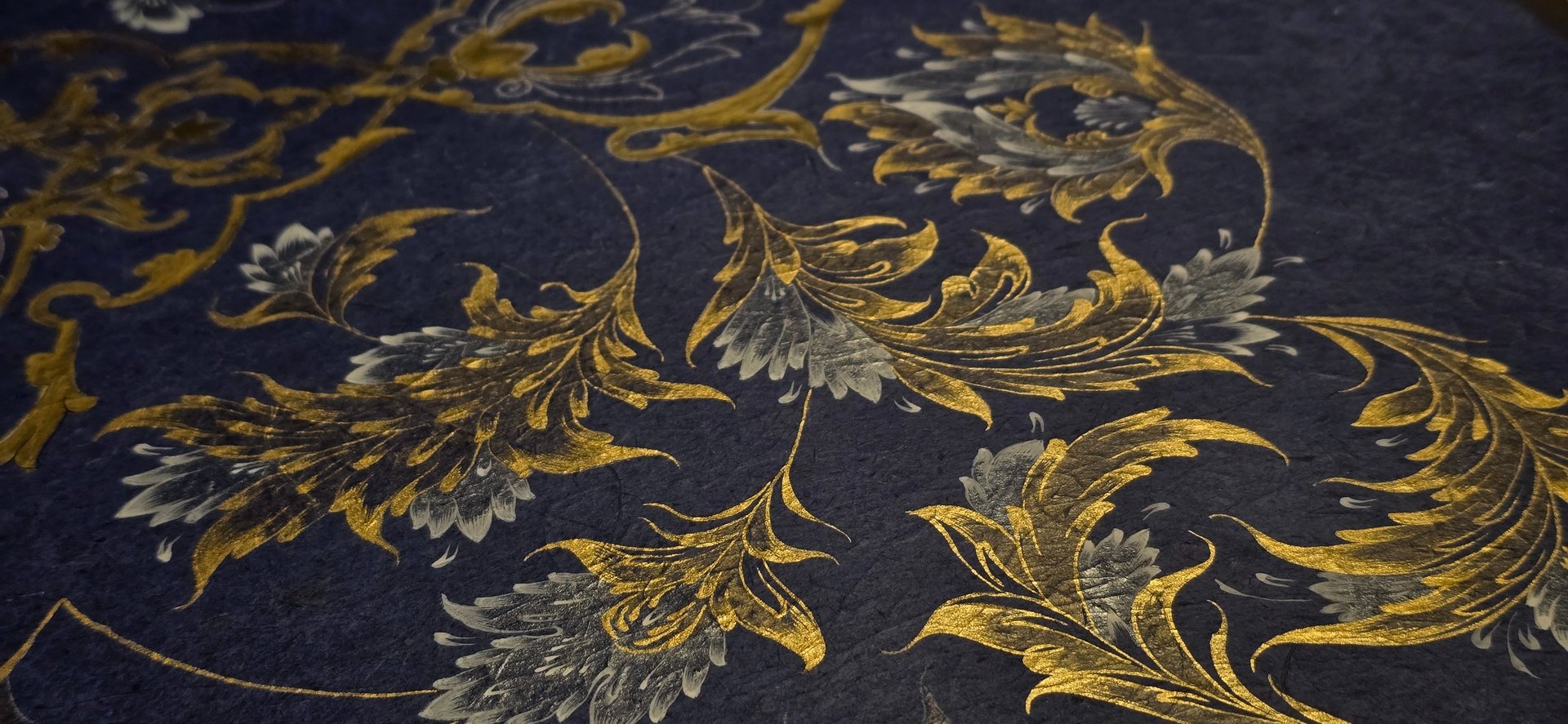
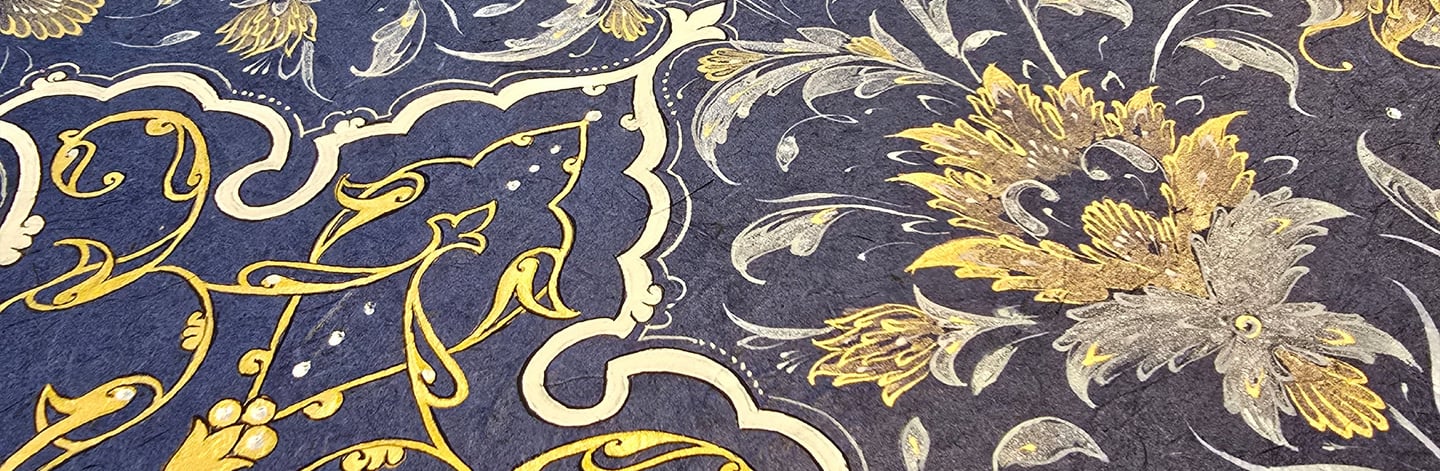
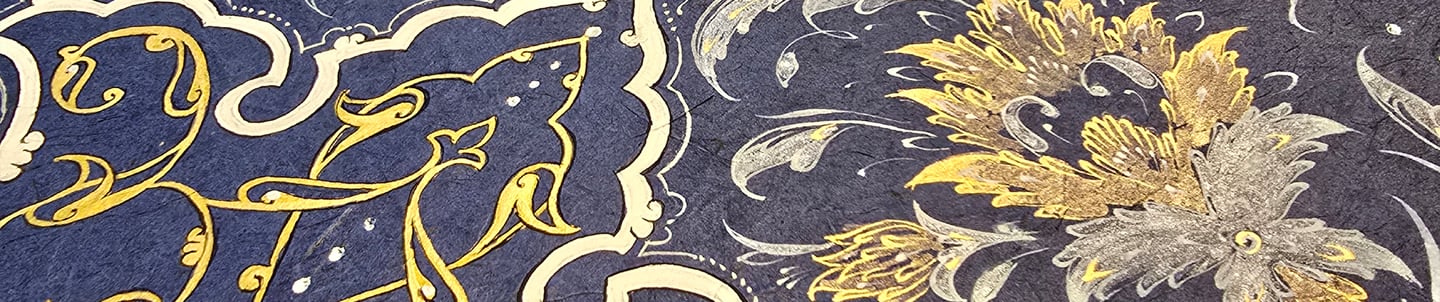
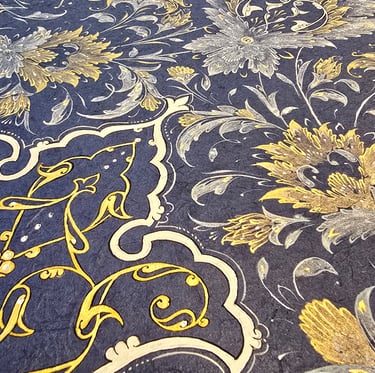
The Eslimi (The Abstracted Spirit): In the strict discipline of Persian painting, Eslimi patterns are traditionally thought to derive from animal sources. These are not merely vines; they are the abstraction of life itself. The grand, sweeping curves you see are stylised derivations of anatomy—imagine the powerful curve of an elephant’s trunk or the graceful, arching neck of a gazelle, abstracted into a perfect, endless mathematical line.
The Khataii (The Floral Earth): The Eslimi rarely dances alone. It is almost always paired with Khataii patterns. These are the authentic floral counterparts, explicitly inspired by botany—leaves, buds, and blossoms.
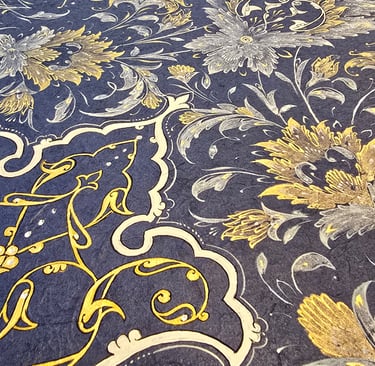
When you view a masterpiece of Persian ornamentation, you are witnessing a harmonious symphony: the structural, abstracted spirit of the animal kingdom (Eslimi) supporting the delicate, blooming beauty of the plant kingdom (Khataii).
The Mathematics of Beauty
Why do these forms captivate us so completely? The answer lies in the philosophy of the infinite.
Whether inspired by a gazelle’s neck or a lotus flower, both Eslimi and Khataii share a singular purpose: Tawhid, or Unity. These designs are constructed using precise geometry to ensure they can be tiled endlessly. They have no focal point, no start, and no finish.
This is the "Geometry of the Spirit." The spiralling lines draw the viewer’s eye into contemplation, moving from the material world to a meditation on the divine nature of the universe—infinite, indivisible, and perfectly ordered.
The Modern Eslimi
In the modern era, when attention is often fragmented, the Eslimi offers a visual sanctuary.
At Nilpar Gallery, we believe that these ancient forms are not relics of the past, but vital components of modern aesthetics. In the contemporary works we curate, such as those by Niloofar K. Afshar, the Eslimi is often deconstructed.
By isolating these motifs stripping away the density of traditional tiling and placing a single, textured gold curve against a modern, negative space we invite the eye to rest. We break the infinite loop just for a moment, allowing you to admire the singular perfection of the curve itself. It is a dialogue between the deep history of the Sassanids and the minimalist boldness of the present day.
A Final Reflection
The next time you encounter these "Arabesques," I invite you to look closer. Look past the general beauty and seek the structure. Can you spot the Eslimi spirals, strong and structural? Can you distinguish them from the delicate Khataii flowers resting upon them?
There is a profound peace in recognizing the order within the complexity. It is a reminder that amidst the chaos of life, there is always an underlying rhythm a beautiful, secret geometry waiting to be found.
We invite you to explore these rhythms further through the curated collection at Nilpar Gallery.


© 2025 Nilpar Gallery — All Rights Reserved.
Join the Collector's Circle
Occasional updates on new works, exhibitions, and writing.