
Blog 01: The Alchemy of Art: The Holy Trinity of Paint & Pigment
From Renaissance masters to modern car factories, every paint relies on the same three ingredients. Get the ratio wrong, and your art falls apart. Discover more through The Alchemy of Art series of blogs and videos.
MATERIAL SCIENCETHE SCIENCE OF ART


If you walk into an art store, the options can feel overwhelming: rows of Oil, Acrylic, Watercolour, Gouache, Tempera, and Encaustic. But chemically speaking, they are all the same thing.
Whether you are looking at a prehistoric cave painting made of colored earth or a high-tech coating on a solar panel, every paint in human history relies on a simple, universal formula. This "holy trinity" of components has remained constant for millennia.
To truly master your materials, you need to stop seeing "brands" and "marketing" and start seeing the chemistry.
1. The Pigment (The Soul)
This is the heart of the paint. Pigments are insoluble, finely divided solid particles that provide colour.
The Science: Unlike dyes, which dissolve in liquids like sugar in tea, pigments remain suspended, like gravel in concrete. This insolubility allows them to stay on the surface rather than be chemically stained.
The History: This component connects you to thousands of years of ingenuity. Renaissance artists, for instance, learned to roast raw earth pigments such as raw sienna and raw umber in ovens, thereby chemically transforming them into the deeper, richer hues of burnt sienna and burnt umber.
Archivability Note: Pigment is the primary determinant of lightfastness. If the pigment itself is chemically unstable under UV light (as in many early synthetic organic pigments or inexpensive neon dyes), no amount of varnish will prevent fading.
2. The Binder (The Glue)
If you just spread dry pigment on paper, it would blow away with a sneeze. You need a "glue" to secure it.
The Science: The binder is the adhesive that surrounds the pigment particles, holds them together, and glues them to the painting surface.
The Function: The binder determines the type of paint you are using:
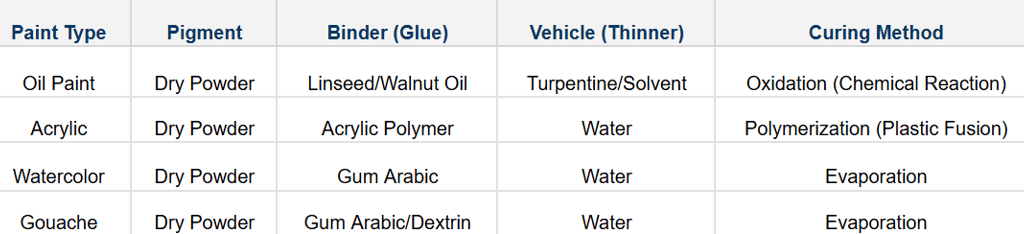
Linseed Oil = Oil Paint.
Acrylic Polymer = Acrylic Paint.
Gum Arabic = Watercolour & Gouache.
Archivability Note: The binder provides structural integrity. If the binder is too brittle, the painting will crack over time; if it yellows (as with cheap linseed oil), the colours will shift.
3. The Vehicle (The Thinner)
Imagine trying to paint with sticky honey or thick tar. You need a liquid to thin the binder down so it flows off your brush.
The Science: The vehicle (often referred to as the solvent or diluent) is the temporary liquid that adjusts the paint's consistency.
The Function: It exists solely to transfer paint from the palette to the canvas. Once its job is done, it evaporates, leaving the pigment and binder behind.
In Oil Paint, this is often Turpentine or Mineral Spirits.
In Gouache and Watercolour, this is simple Water.
The "Golden Ratio" and Why Paints Fail
This is where the science of archivability begins. A perfect tube of paint is a delicate balance of these three elements. If you are mixing your own paints or buying from brands that don't respect the chemistry, you will encounter Ratio Failure:
Under-bound (Too Much Pigment):
The Look: Very matte and intense colour.
The Risk: There isn't enough "glue" to hold the powder. The paint will "dust off" or "chalk" if rubbed after drying. This is a common issue in cheap poster paints.
Over-bound (Too Much Binder):
The Look: Very glossy and transparent.
The Risk: The paint surface becomes "plastic-like" or gummy. In gouache, excess binder can cause cracking because the thick gum layer shrinks significantly as it dries.
Summary Table: The Paint Family Tree
A Note on Modern Relevance
Why does a lover of art need to know the chemistry of the studio? Because understanding deepens our reverence for the why. When you stand before a piece at Nilpar Gallery, you are not merely looking at an image; you are witnessing a suspended chemical reaction that has been stabilised by the artist's hand, intended to endure for centuries.
We invite you to view our current curation with fresh eyes, looking past the image to see the exquisite material craft that makes it possible.
In our next journal entry, we will delve deeper into Pigments, asking: Why are some colours naturally opaque while others whisper in transparency?
# Pigments #Binders #Paint Chemistry #Archivability #Lightfastness #Gouache #Watercolor #Oil Painting #Acrylics #Art Preservation #Paint Mixing #Color Theory
© 2025 Nilpar Gallery — All Rights Reserved.
Join the Collector's Circle
Occasional updates on new works, exhibitions, and writing.