
The Infinite Azure: Blue in Persian Art, Memory, and Night
Explore the profound symbolism of blue in Persian art. From the stillness of the night sky to the "Sapphire Garden," discover why this color invites deep contemplation.
ART HISTORY


Into the Quiet
Imagine standing beneath the dome of a grand mosque in Isfahan just as the sun dips below the horizon. The heat of the day dissipates, and the blazing gold of noon surrenders to the cool, enveloping embrace of twilight. This is the realm of blue.
In the lexicon of Persian aesthetics, blue is not merely a hue; it is an atmosphere. It is the colour of the night sky, of water, and of the infinite. Unlike the fiery reds and oranges that rush toward the eye, demanding immediate attention, blue recedes. It steps back. It creates a vast, hollow space that invites the viewer to step in, to breathe, and to remember.
It is in this recession, this visual quietness, that we find the true power of Persian art. It is a whisper rather than a shout, asking us to slow down and listen to the silence between the shapes.
The Mathematics of Stillness
To understand the function of blue in Persian geometry, one must understand the architecture of the soul. Historically, the pigments used to create these ceramics—often derived from precious Lapis Lazuli or Cobalt—were as valuable as gold. But their value lay not only in their cost but also in their spatial capability.
In the intricate grid of a geometric pattern, blue often serves as the "void" or the universe that holds the stars.
The receding horizon: blue wavelengths are shorter and scatter more readily, causing the eye to perceive the colour as further away. Persian artisans mastered this optical illusion. By using deep indigos and turquoises as backgrounds, they created depth on flat surfaces without relying on Western linear perspective.
The Pause: In illuminated manuscripts, blue functions as a "visual pause." It is a place for the eye to rest. Amidst the complexity of interlacing lines and mathematical precision, the blue expanses offer a moment of stillness, allowing the logic of the pattern to sink in.
It balances the active energy of gold and the material weight of terracotta, serving as a bridge between the material world and the spiritual realm.
A Garden Held in Blue
How does this ancient language translate to our modern lives? In a world that is increasingly loud and fractured, the "quiet intensity" of blue is more necessary than ever.
Contemporary design often seeks to shock or stimulate. However, at Nilpar Gallery, we observe a return to the introspective. We observe this philosophy embodied in works such as the Sapphire Garden. Here, colour is used not for spectacle but for structure.
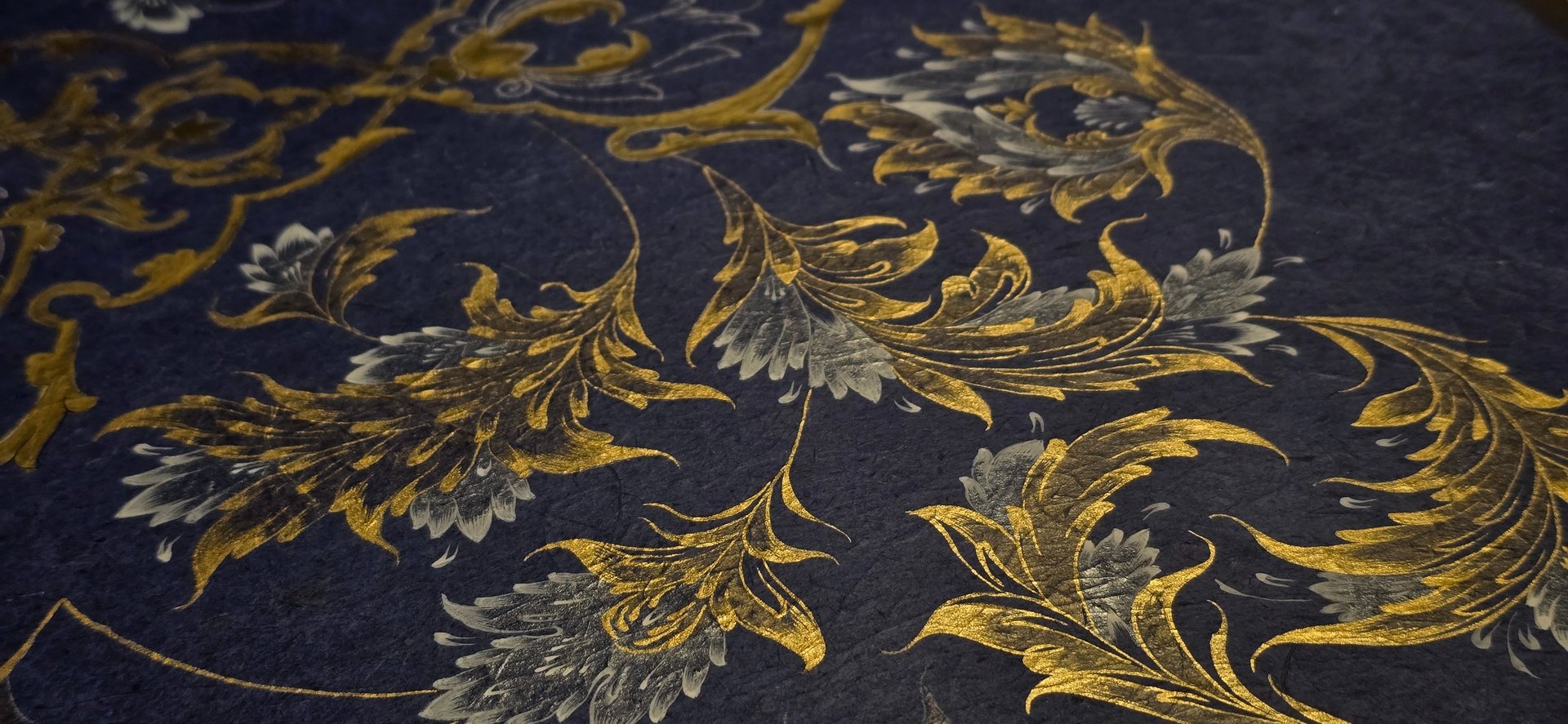
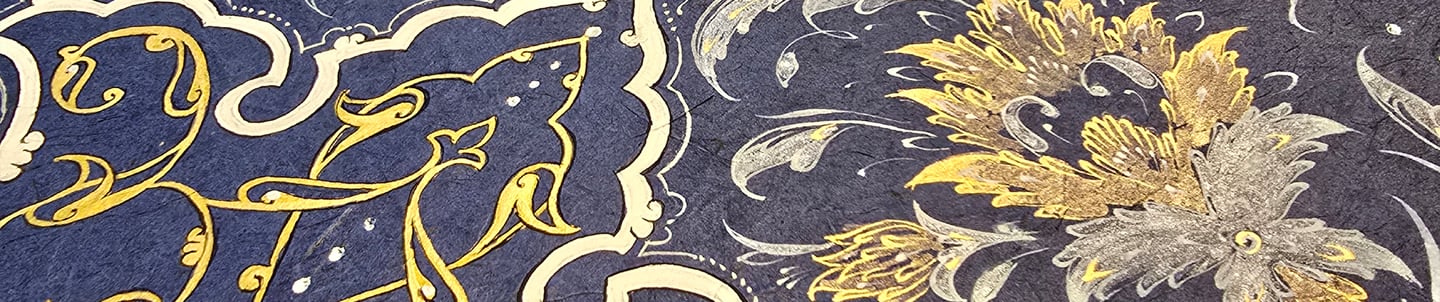
In the Sapphire Garden, the blue does not unfold outward; it holds inward. It creates a sanctuary of memory. It suggests that the most beautiful gardens are not the ones we walk through physically, but the ones we cultivate within our own minds—spaces of reflection, longing, and peace. The ornament breathes within the blue, emerging gradually like stars appearing in the evening sky.
An Invitation to Reflect
Blue is the colour of memory because it evokes what lies beyond the immediate. It is the horizon line that we can never quite reach, yet always yearn for.
We invite you to examine the patterns around you more closely. Find the spaces where the colour deepens, where the noise fades, and where the infinite begins. The beauty of the Sapphire Garden and the tradition it embodies is waiting to be contemplated, not merely seen.
You are always welcome to wander through our curated collection at Nilpar Gallery, where history and modern aesthetics meet in quiet conversation.
A Garden Held in Blue
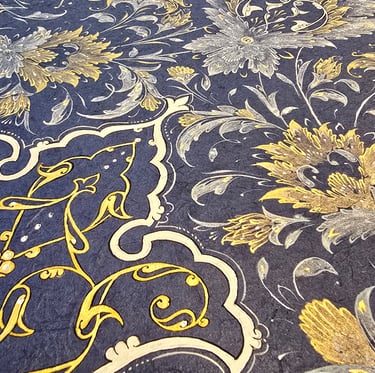
This atmosphere is present in Sapphire Garden, where blue structures the composition as a space of memory and reflection. The garden does not unfold outward; it holds inward, offering contemplation rather than spectacle.

© 2025 Nilpar Gallery — All Rights Reserved.
Join the Collector's Circle
Occasional updates on new works, exhibitions, and writing.