
The Eslimi Motif: The Living Breath of Persian Ornament
Explore the fluid beauty of the Eslimi motif. Discover how these infinite spirals represent growth, breath, and the balance between order and freedom in Persian art.
ART HISTORY
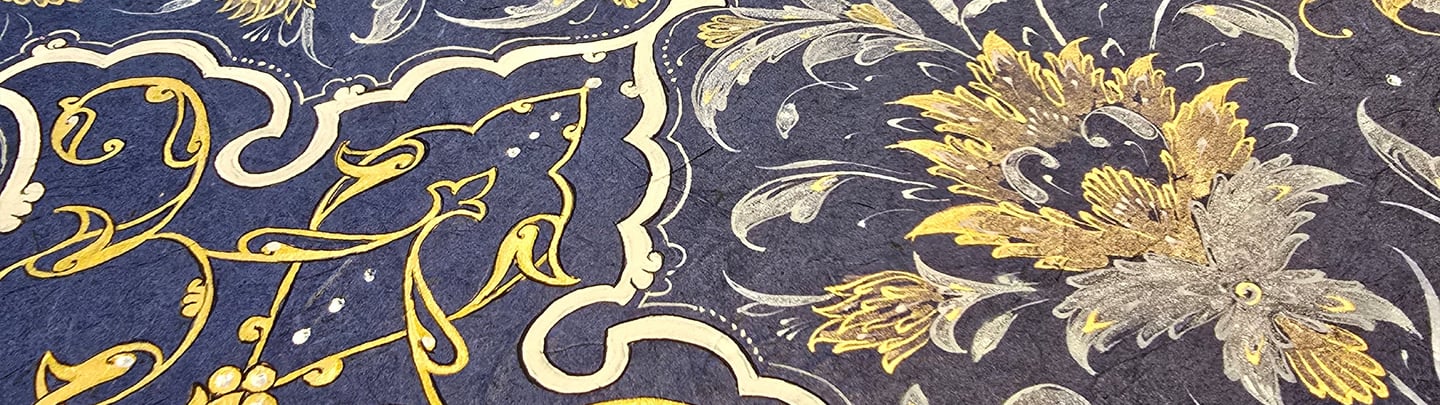
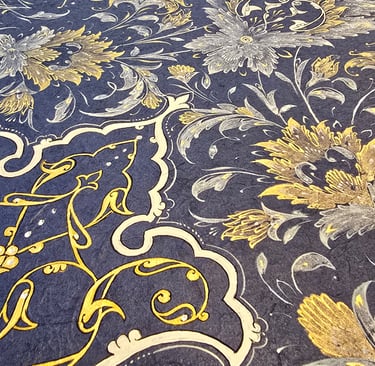
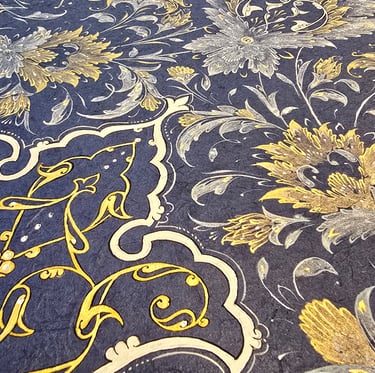
The Eslimi Motif as a Living Form
To trace the line of an Eslimi spiral is to follow a breath that was exhaled centuries ago, yet remains perpetually in motion.
Imagine standing in the cool shade of a Safavid iwan. Your eye catches a single turquoise vine rising from the base of the arch. It does not move in a straight line; it undulates, turns back upon itself, branches out, and continues upward. It is not merely a depiction of a plant; it is the visual architecture of life itself.
In the curated philosophy of Nilpar Gallery, we view the Eslimi not as a static historical artifact, but as a living structure a testament to movement without destination, and continuity without closure.
The Architecture of Breath
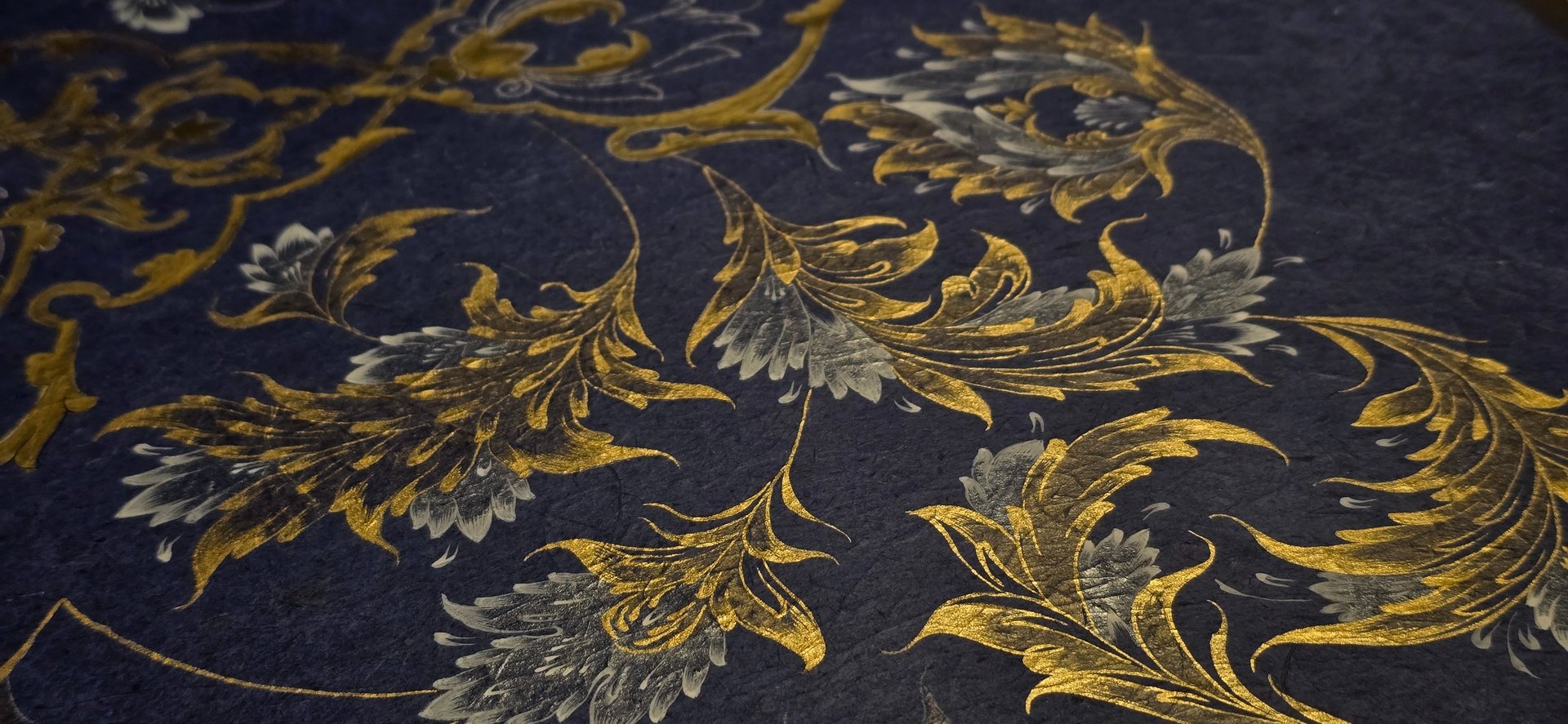
The term Eslimi (often referred to in the West as the Arabesque) refers to the rhythmic, biomorphic curves that define the "vegetal" side of Persian ornament. While its counterpart, Girih, speaks the language of stars and rigid polygons, Eslimi speaks the language of the vine.
However, to call it "floral" is a reduction. Eslimi does not seek to copy nature; it seeks to capture the essence of growth.
"Lines extend, return, and transform, creating a sense of perpetual motion. This movement is not dramatic; it is measured, intentional, and calm."
The Mathematics of the Spiral
Beneath the organic flow of the Eslimi lies a hidden rigor. These curves are often governed by the logic of logarithmic spirals, where the radius of the curve increases at a constant rate.
Consider the geometry:
The Spine: The central stem that dictates the flow.
The Node: The precise mathematical point where a branch splits or a leaf unfurls.
The Infinite: Unlike a circle which closes, the spiral implies $r \rightarrow \infty$.
This mathematical foundation ensures that even in its wildest complexity, the Eslimi never descends into chaos. It represents a universe where freedom and order are not opposing forces, but partners in a dance.
Continuity and Balance
In Persian visual culture, the concept of Nafas (breath) is vital. The Eslimi motif functions as a visual metaphor for this breath the inhale and the exhale.
Unlike geometric patterns that rely on strict, mirror-image symmetry, Eslimi compositions balance repetition with variation. No two spirals are identical, yet they remain in dialogue. This reflects a profound philosophical worldview: harmony arises through adaptation rather than rigidity.
The motif becomes a visual language of continuity. It resists interruption. When the pattern reaches the edge of a tile or a page, it does not end; it merely passes out of view, implying that the beauty continues beyond the frame of our vision.
A Form That Guides: Contemporary Relevance
Why does a motif perfected in the 15th century matter in the modern era? Because we live in a world of fragmentation. Our attention is fractured; our movements are often rushed and linear.
Contemporary artists working with Persian-inspired ornament—including those we admire at Nilpar—are returning to Eslimi as a conceptual anchor. They are stripping away the color to focus on the structure.
The Guiding Flow
This sensibility is palpably present in the concept of The Guiding Flow. In modern interpretations, Eslimi-inspired movement shapes the composition without imposing a rigid direction. It is a soft authority.
The work allows form itself to become a quiet guide, unfolding through rhythm rather than instruction. It invites the modern viewer to stop analyzing and simply breathe with the line.
An Invitation to Observe
The beauty of the Eslimi motif lies in its patience. It waits for the viewer to slow down.
At Nilpar Gallery, we are dedicated to preserving this intersection of ancient geometry and modern fluidity. We invite you to spend a moment with these forms—whether in a museum, a book, or through our digital curation. Look for the spiral that does not end. Follow the vine that guides the eye gently, encouraging slow looking rather than immediate comprehension.
In that continuity, you may find a moment of stillness.
© 2025 Nilpar Gallery — All Rights Reserved.
Join the Collector's Circle
Occasional updates on new works, exhibitions, and writing.