
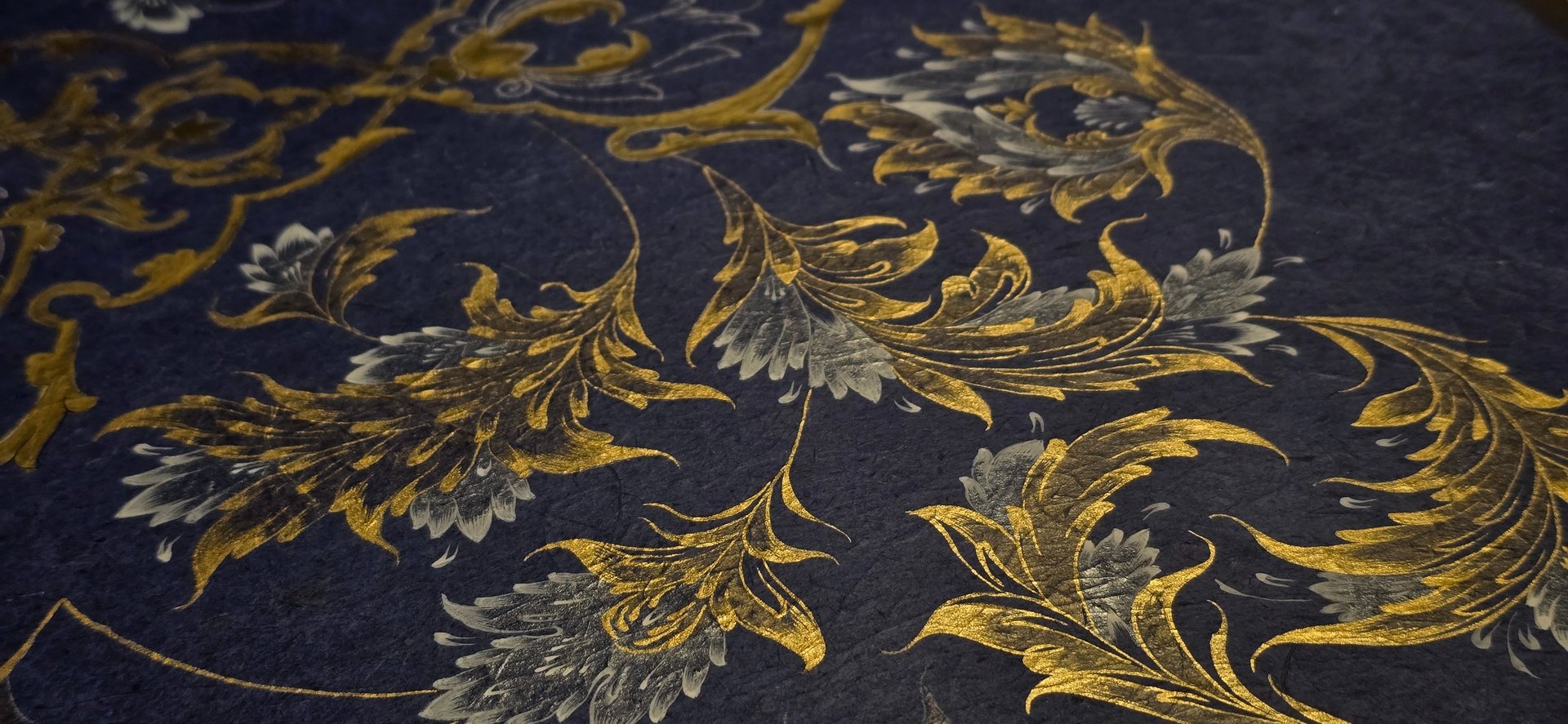
The Eslimi Motif: Unveiling the Soul of Persian Spirals
The Eslimi Motif - Discover the history and symbolism of the Eslimi motif. Explore how this ancient Persian spiral represents infinity, nature, and divine order in art.
The Breath of the Infinite
Imagine, for a moment, standing beneath the vast, turquoise dome of the Sheikh Lotfollah Mosque in Isfahan. As your eyes adjust to the light, they are not drawn to a single focal point, but rather swept up in a rhythmic dance. A vine emerges from nowhere, splits, curls upon itself, and gives birth to another leaf, spiraling endlessly upward toward the apex of the dome.
This is not merely decoration; it is visual theology. It is the Eslimi.
In the curated halls of Nilpar Gallery, we often speak of the silence found within patterns. While geometric knots (Girah) speak to the crystalline structure of the universe, the Eslimi speaks to its breath—the organic, rhythmic pulse of life itself.
Defining the Eslimi: More Than a Vine
To the untrained eye, the Eslimi might appear simply as a floral design or a generic arabesque. However, in the lexicon of Persian aesthetics, it holds a distinct and sacred place.
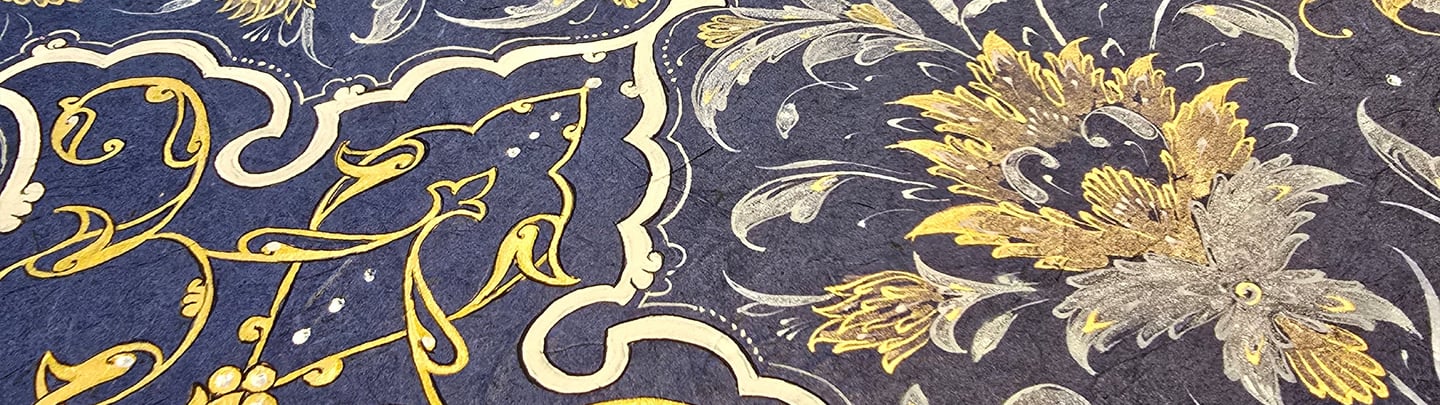
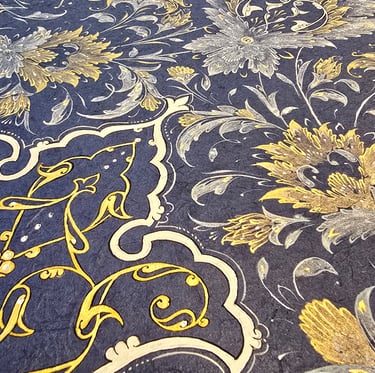
The Eslimi (or Islimi) is a stylized, biomorphic motif characterized by spiraling vines and rhythmic curves that possess no visible beginning or end. Unlike naturalistic botanical illustrations, the Eslimi is an abstraction. It captures the idea of a plant—its growth, its reaching toward the sun—rather than the physical reality of a specific flower.
"The spiral is not just a shape; it is a map of the eternal. It represents a realm without boundaries, where the beginning and the end are indistinguishable."
The Anatomy of Harmony
How does one distinguish a true Eslimi from other ornamentation? We look for the "Mathematics of Beauty"—a specific set of structural rules that govern its elegance.
The Curvilinear Spine: Unlike the angular, masculine energy of geometric knots, the Eslimi is entirely curvilinear. It relies on the perfect spiral, often adhering to the Golden Ratio, guiding the viewer’s eye in a smooth, unceasing motion.
The Khatai (Split Leaf): This is the hallmark of the motif. The vines often terminate or pause at a stylized bud that appears to split open. This "opening" symbolizes potentiality—the unfolding of life and the generosity of nature.
Infinite Continuity: The design is fractal in nature. A master artist designs an Eslimi not as a contained image, but as a window into an infinite grid. Theoretically, the spirals could extend forever beyond the frame of the tile or canvas.
A Lineage of Resilience
While the Eslimi became a defining feature of the Islamic Golden Age (specifically from the 9th century onward), its roots are ancient. It traces its lineage back to the Sassanian Empire and the vine scrolls of Byzantium. It is a survivor, adapting through centuries of cultural shifts, yet always retaining its core identity: the celebration of the Garden of Paradise.
In traditional philosophy, this endless curve serves a meditative purpose. By following the line with one's eye, the viewer is invited to detach from the chaos of the material world and enter a state of contemplation.
The Eslimi in the Modern Gaze
Why does this ancient spiral matter today? In our modern era of rigid digital grids and sharp architectural angles, the Eslimi offers a necessary softness.
Contemporary artists are now reclaiming this motif, stripping away the heavy ornamentation of the past to reveal the purity of the form. At Nilpar Gallery, we are particularly moved by the work of artists like Niloofar K. Afshar.
Afshar’s approach is one of deconstruction. She does not use the Eslimi merely as a border for text or image; she treats the curve itself as the protagonist. By isolating these spirals—often illuminating them with 24k Gold Leaf—she removes the surrounding "noise." This technique forces us to confront the weight and grace of the curve in isolation, transforming a repetitive pattern into a singular, sculptural moment of gold suspended in white space.
An Invitation to Continuity
The Eslimi teaches us that beauty is not static; it is a movement. It is a reminder that we are part of a larger, unfolding narrative.
We invite you to explore the collection at Nilpar Gallery, not just to view art, but to witness the conversation between history and the present moment. Whether etched in ancient tile or brushed in modern gold, the spiral continues its dance.
Would you like to explore how these biomorphic patterns contrast with the rigid geometry of Girah knots in our next discussion?
© 2025 Nilpar Gallery — All Rights Reserved.
Join the Collector's Circle
Occasional updates on new works, exhibitions, and writing.