
What is the Eslimi Motif?
A Guide to Persian Spirals
Niloofar K. Afshar
12/15/20251 min read
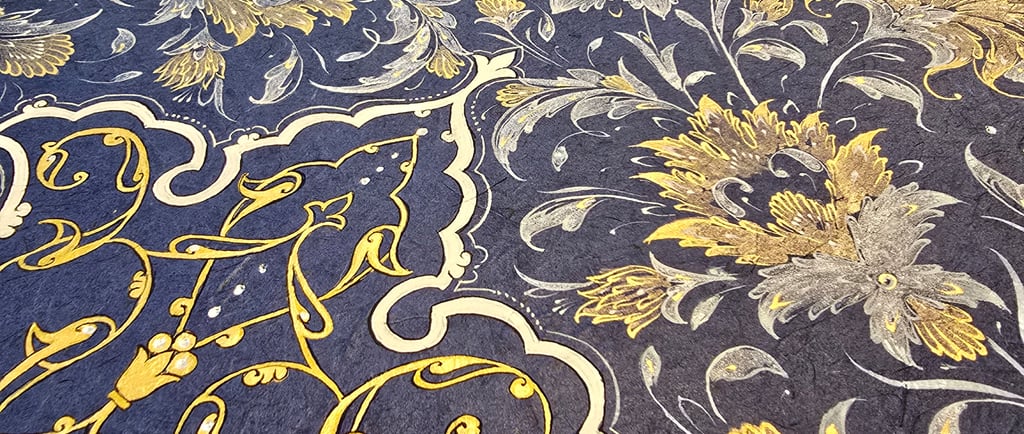
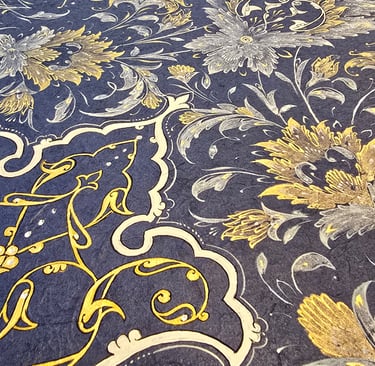
In the world of Persian art and Islamic geometry, few patterns are as iconic as the spiral. Known as the Eslimi, this rhythmic vine motif is the backbone of centuries of artistic heritage, from the Blue Mosque to modern contemporary paintings.
But what exactly is the Eslimi, and how does it differ from a standard arabesque?
Definition: What is the Eslimi?
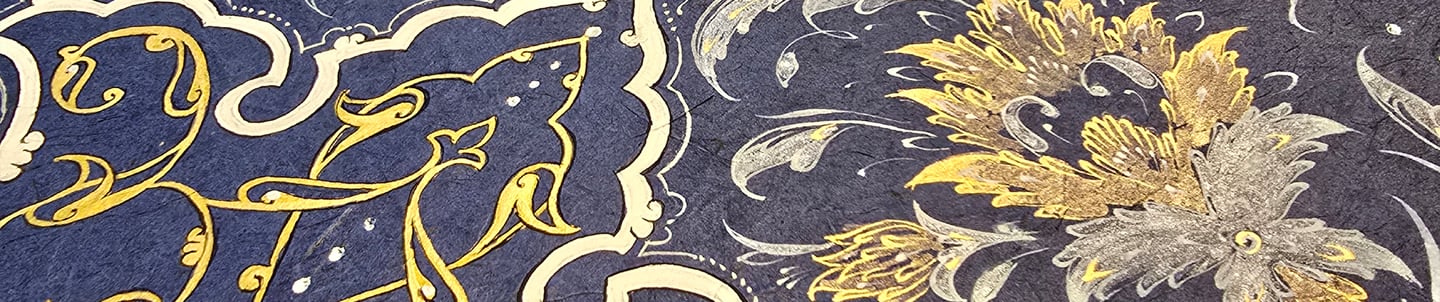
The Eslimi (or Islimi) is a stylized decorative motif in Persian art characterized by spiraling vines, biomorphic leaves, and rhythmic curves that have no visible beginning or end. Symbolizing the infinite nature of creation, the pattern relies on mathematical symmetry to create a sense of perfect, eternal order.
Key Characteristics of the Motif
To identify a true Eslimi pattern, look for these three elements:
The Spiral Structure: Unlike geometric knots which are angular, the Eslimi is always curvilinear, based on the growth patterns of plants.
The "Split Leaf" (Khatai): The vines often sprout stylized leaves or buds that split open, representing life and potential.
Infinite Continuity: The design is fractal-like; it creates a framework that could theoretically extend forever beyond the borders of the artwork.
History & Symbolism
While popularized during the "Golden Age" of Islamic art (9th century onwards), the roots of the Eslimi trace back to the Sassanian Empire and ancient Byzantine vine scrolls. In traditional philosophy, the spiral is not just decoration it is visual theology. The endless curve represents the divine realm, a place without boundaries or time.
Eslimi in Contemporary Art
Today, modern artists are reimagining this ancient form. Instead of using the Eslimi as a background border, they deconstruct it, treating the curve itself as the subject matter.
At Nilpar Gallery, artist Niloofar K. Afshar isolates these spirals using 24k Gold Leaf, stripping away the surrounding noise to focus on the "weight" of the curve. This technique transforms the motif from a repetitive pattern into a singular, sculptural moment.
See how the Eslimi is reimagined in modern painting: Read Deconstructing the Eslimi.
© 2025 Nilpar Gallery — All Rights Reserved.
Join the Collector's Circle
Receive invitations to private viewings and new releases.